Tuesday, 24 February 2015

Divorced wife told to get a job and stop living off her ex-husband in a landmark judgment


An Appeals Court judge has told the ex-wife of a millionaire racehorse surgeon to get a job and stop thinking she has the right to expect “an income for life” at her former husband’s expense.
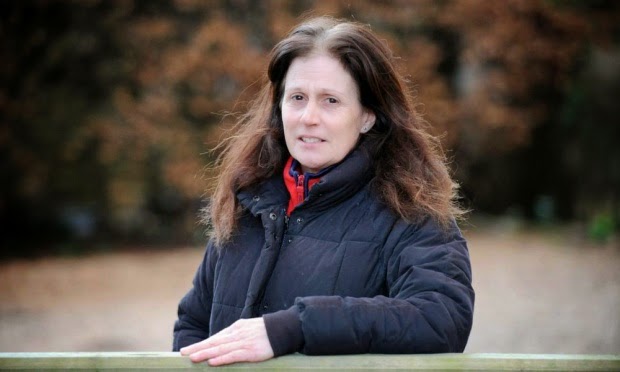
Tracey Wright. Pic Courtesy: The Guardian
Lord Justice Pitchford said divorcees with children aged over seven should work for a living in a noteworthy decision which signals an end to leisurely living for ex partners of wealthy spouses. 

Former riding instructor and mother-of-two Tracey Wright, 51, chose not to be a working mother when she split up with top equine surgeon Ian Malcolm Wright in 2008. 

After 11 years of marriage, the couple's £1.3 million, seven-bedroom home, set in 16 acres of Suffolk countryside, was ordered to be sold and the proceeds split. 

Mrs Wright came away with a £450,000 mortgage-free house in the heart of riding country, in Newmarket, Suffolk, plus stabling for her horse and her daughters' ponies. 

Her ex-husband was also ordered to pay her and the children £75,000-a-year in maintenance and school fees. 

However, last year Mr Wright, 59, who is one of UK’s top vets, went to the High Court to seek a cut in his bills. 

He protested it was not fair that he be expected to keep supporting his ex-wife indefinitely, even after his retirement, whilst she made "no effort whatsoever to seek work". 

A family judge's reaction was to respond to Mrs Wright, of Wickhambrook, Newmarket, with "harsh words." 

The mother was told to "just get on with it" and get a job, like "vast numbers of other women with children." 

Lord Justice Pitchford, sitting at the Court of Appeal, has now rejected her challenge to the decision to slash her future maintenance. 

Mr Wright runs a cutting edge equine hospital in Newmarket, carrying out life-saving surgery on top-class horses, including former Derby and Oaks winners and stallions at stud worth tens of millions of pounds. 

He and Mrs Wright, a former legal secretary and riding instructor, married in 1997 and divorced in 2008, having separated in 2006. 

As part of the divorce order, Mrs Wright, who lives with the couple's youngest daughter, aged 10, was handed £75,000 yearly payments, of which £33,200 was spousal maintenance for her personal upkeep. 

The court was worried that supporting his wife would be unaffordable after Mr. Wright retires at the age of 65. 

Judge Lynn Roberts last year agreed that there was no good reason why Mrs Wright had not done a stroke of paid work in the six years since the divorce. 

The judge criticised her for being "evasive on the subject of her own earning capacity".
"The world of work has innumerable possibilities these day...vast numbers of women with children just get on with it and Mrs Wright should have done as well," the judge said.

"I do not think the children will suffer if Mrs Wright has to work, and indeed a working mother at this stage of their lives may well provide them with a good role model. 

"It is possible to find work that fits in with childcare responsibilities. I reject her other reasons relating to responsibilities for animals, or trees, or housekeeping.

"Mrs Wright has made no effort whatsoever to seek work or to update her skills...I am satisfied that she has worked on the basis...that she would be supported for life. 

"It is essential... that she starts to work now," said the judge, who ordered that her personal maintenance payments from her ex-husband must cease, with a gradual tailing off over a five-year period leading up to his retirement. 

Counsel Mark Johnston, for the wife, challenging that ruling, protested that having to care for a 10-year-old - the couple's older daughter being a boarding pupil at a public school - "is an inherent restriction on her ability to develop any kind of earning capacity in the next five years." 

He warned that Judge Roberts' order would cause "a plummeting in the standard of living" of the youngest child. 

The assets Mrs Wright received in the split "wouldn't come anywhere near allowing the wife to adjust without undue hardship...especially with one child still at home." 

Upholding Judge Roberts' ruling, however, Lord Justice Pitchford confirmed that it is now "imperative that the wife go out to work and support herself." 

"The time had come to recognize that, at the time of his retirement, the husband should not be paying spousal maintenance," he said. 

"The wife had done nothing since 2008 to look for work, retrain or to prepare herself for work. 

"Judge Roberts did not accept any of the explanations put forward by the wife for her inactivity and ruled that it was important that she obey the order. 

"She had harsh words for the wife for her complete failure to confront her obligation to contribute financially. She found the wife exaggerated her income needs. 

"There is a general expectation that, once children are in year two, mothers can begin part time work and make a financial contribution," he went on. 

Mr Wright had been found to be "a man of integrity who had done nothing to mislead the court". 

"But the judge found the wife was an unsatisfactory witness; particularly on the subject of her own earning capacity she was evasive", he added. 

"The judge made it very clear that, within a couple of years, she would be expected to contribute financially. 

"The question is whether there is a real prospect of establishing that the judge gave inadequate reasons for her decision that the husband should provide no spousal maintenance in his retirement. In my view there is no such prospect." 

Lord Justice Pitchford said that "the order was never intended to provide the wife with an income for life". 

And he concluded: "The onus will henceforth be on her. This application is dismissed."

Monday, 23 February 2015

Teesta Setalvad's bail plea posted before new bench after judge's recusal: Supreme Court Registry


In new twist to the controversy over a new Bench hearing Teesta Setalvad's anticipatory bail plea, the Supreme Court registry has said that Teesta's bail plea was posted befrore another bench on the recusal of a judge in the previous bench.


Referring to news reports that Chief Justice of India H L Dattu had transferred Setalvad’s plea to a bench headed by Justice Dipak Misra despite the fact that neither of the judges of the previous bench, justices S J Mukhopadhya and N V Ramana, had recused, an apex court registrar said it has “no basis or substance”.

The Registry however, declined to identify which of the two judges - Justice Mukhopadhyay or Justice Ramana -had sought recusal.

“Whatever has been done has been done at the direct recusal of one of the Hon’ble judges of the previous bench. Assigning a case to a bench is in the administrative domain of the Hon’ble Chief Justice of India,” M K Hanjura, Registrar of the Supreme Court said.

“Whatever has been reported has no basis and no substance,” he said, adding that media should not report “incorrect facts”.

The bench of justices S J Mukhopadhyaya and N V Ramana, on February 13, had extended interim protection by six more days against arrest to Setalvad and her husband Javed Anand in a case of alleged embezzlement of funds for a museum at Ahmedabad’s Gulbarg Society that was devastated in the 2002 riots. It had posed some tough queries to the couple.

However, the matter was later transferred to a new bench comprising justices Dipak Misra and Adarsh Kumar Goel which on February 19 restrained Gujarat police from arresting them and later reserved its verdict of their plea

Saturday, 21 February 2015

Madras High Court Advocates Association moves the Madras High Court challenging the list of 9 persons forwarded by the collegium for appointment as judges


The Madras High Court Advocates’ Association (MHAA) has filed a writ petition before the Madras High Court seeking a direction to the Supreme Court Secretary-General and others to send back the list of nine persons recommended for filling vacancies of judges in the Madras High Court.
 
Madras High Court

At present, there are 18 vacancies in the High Court. The sanctioned strength of judges is 60. A similar situation was witnessed in January last year when a PIL was filed seeking the return of a list of 12 names suggested then by the High Court collegium. The list was ultimately sent back.

In the present petition, the MHAA secretary, S.Arivazhagan, submitted that the High Court collegium had recommended nine names for appointment. The association had requested the court to consider persons from unrepresented communities in strict compliance with the constitutional mandate of achieving social justice.

The association said the present collegium system of selecting judges was much criticised by experts and advocates. Ultimately, the sufferers were the litigant public. It was being openly spoken at the Bar that some judges appointed were indecisive due to non-exposure in various fields of law. Despite the increase in the number of judges, quality and quantity of disposals had remained unsatisfactory. This was because in the collegium system there was no yardstick for selecting suitable candidates. The process of consultation was conspicuously absent.

The petitioner said the association wanted the entire vacancies to be filled up by upholding social justice. The Association has sought for a direction to the authorities concerned to drop the present move of appointing nine persons as judges to the 9 vacancies in the Madras High Court and for a direction to them to redo the same afresh, after taking into consideration the demands of the advocates.
 

B.S Yeddyurappa cannot claim immunity from prosecution on the ground of lack of sanction as defrauding the exchequer is not part of a public servant's official duties, submits the CBI before the Supreme Court


Opposing former Karnataka chief minister B.S Yeddyurappa’s plea for quashing of the charge-sheet against him and his two sons, the CBI told the Supreme Court on Friday that it had evidence to back its charges accusing the former CM of unilaterally de-notifying a piece of land marked for acquisition by Bangalore Development Authority for Arkavati Layout, and then allowing his sons and son-in-law to sell it at an exorbitant price to South West Mining Ltd.
 
Yeddyurappa has sought quashing of the cases registered by the CBI against him on the ground of lack of sanction from the Governor for prosecuting him.
 
Rebutting this contention of Mr. Yeddyurappa, the Central Bureau of Investigation has submitted before the Supreme Court that former Karnataka chief minister B.S Yeddyurappa cannot claim immunity from prosecution on the ground of lack of sanction as defrauding the exchequer was not part of a public servant's official duties. 
 
File picture : former Karnataka Chief Minister B.S. Yeddyurappa

Under the Criminal Procedure Code, the governor's sanction is required to prosecute any public servant, including chief minister or other ministers. Yeddyurappa is accused of granting land at throwaway prices and hastening environmental clearances to certain companies in return for funds worth crores of rupees being put into some family run trusts. He is also accused of imposing a ban on mining imports into the state to benefit some companies.

These actions are alleged to have cost the state exchequer a loss of an estimated Rs 876.90 crore. CBI filed a chargesheet in May 2012 under court directions against Yeddyurappa, his sons BY Vijayendra and BY Raghavendra and son-in-law RN Sohan Kumar. 

Among those who figure in the chargesheet are Prerna Educational and Social Trust, JSW Steel, South West Mining Ltd and certain other local companies which paid unspecified amounts into the trusts. 

Yeddyurappa later moved the Apex court seeking quashing of the charge sheet in the case on  the ground that the governor's sanction was not obtained, as needed under Section 197 of the Criminal Procedure Code to prosecute a public servant. CBI has stoutly opposed his contentions in its affidavit filed on Friday. 

The CBI also said in its affidavit filed before the Court that it had documentary evidence to prove that the Yeddyurappa family-run Prerana Educational and Social Trust had received Rs 10 crore in donation from JSW Steel Ltd through various firms as a quid pro quo for favours shown by the then CM to JSW. "It is a matter which needs to be taken to its logical end," the agency said.
 

The CBI has also claimed that Yedduurappa had misused his official position as urban development minister to de-notify government land to enable his family members to purchase plots and later sell them at concessional rates in return for quid pro quo investments in the trusts. "Yeddyurappa was directly involved in the de-notification of the land, which was purchased by his kin by resorting to forgery and other illegal means and got undue benefits. Yeddyurappa himself took the decision to de-notify the land, bypassing the De-notification Committee which alone was competent to consider requests for de-notification of land marked for acquisition," the investigation agency said. 

 Yeddyurappa has been charged with criminal conspiracy and of committing offences punishable under Sections 13(1(d) and 13 (2) of the Prevention of Corruption Act.